
by Bitso on Feb 03, 2026

This content is for informational purposes only. It does not constitute financial, legal, tax or regulatory advice. Each company should validate its operations with its internal teams and advisors.
Your buyer pays once, but your seller, your logistics partner and your platform fee should each be paid at a different moment. How do you release each part in pesos without prefunding a Mexican account?
This article explains how to execute split payouts across cross-border payments in Latin America using stablecoins for business payments, while maintaining a seamless user experience and full financial oversight.
For broader context on why programmable, tokenized cash is reshaping B2B settlement, see McKinsey’s analysis on tokenized cash enables next-gen payments.
What is a split payout, and why is it hard across borders?
A split payout divides the funds of one order among several beneficiaries, each with its own amount and reference. Marketplaces, delivery apps, travel platforms and creator platforms all run some version of it.
Three things make it hard in cross-border payments in Latin America:
- Timing. The buyer pays today, but the seller should only get paid after delivery. Holding and releasing funds line by line is difficult when the money arrives as one bank transfer.
- Conversion. Collections arrive in dollars and payouts go out in pesos. Buying pesos days in advance means guessing volumes and holding idle cash.
- Reconciliation. One bank statement line has to be matched against several beneficiaries, commissions and withholdings. Partial refunds make it harder.
Large payment companies already treat multi-party flows as a product of their own. Stripe’s stablecoin payments documentation shows that platforms on Connect, its product for marketplaces that route money between customers and sellers, can accept stablecoin payments and settle in local currency.
How do stablecoins for business payments handle a split payout?
In this model, the platform holds order funds in USDC or USDT, digital dollars issued by Circle and Tether described as 100% backed by cash and cash-equivalent assets and redeemable 1:1 for US dollars. The order is then divided into payout lines that move independently:
- Collect and hold in dollars. The buyer’s payment is held in USDC or USDT, so the platform keeps dollar value until each release without prefunding a peso account.
- Divide the order into payout lines. Each beneficiary gets a line with its amount, CLABE or wallet, and a reference tied to the order ID, for example ORDER 8841 SELLER.
- Set a release condition per line. The seller’s line waits for delivery confirmation. The logistics line waits for pickup. The commission line is booked right away.
- Convert and deliver in pesos. When a condition is met, only that line converts from USDC or USDT to MXN and lands in the beneficiary’s bank account through SPEI, the instant payment system that Banco de México operates 24/7.
- Reconcile automatically. Every status change (created, released, credited or failed) reaches your ERP (enterprise resource planning system) through a webhook, an automatic notification sent when a payout changes status, so each line closes against the original order.
The seller never touches crypto. They see pesos in the bank account they already use, with a reference that matches the order in your seller portal.
|
How stablecoins for business payments help operations and finance align on faster, auditable payouts |
|
|---|---|
|
Operations |
Finance |
|
Fewer payout-status tickets with real-time webhooks (accepted → released → exception closed). |
Two-person approval embedded; no duplicate protection → no release by design. |
|
One API to run split payouts and mass payouts in Latin America, no parallel processes. |
Audit-ready evidence per transaction (timestamps, request/response hashes). |
|
Idempotent retries that prevent duplicate payouts. |
Beneficiary-level reconciliation auto-posted to ERP/TMS. |
|
SLA visibility (T+0/T+1) per beneficiary and batch. |
Quote-before-send transparency across cross-border payments in Latin America. |
|
Self-serve exception playbooks with clear reason codes. |
Lower buffer cash via USDC or USDT to MXN liquidity. |

How USDC or USDT to MXN liquidity improves payouts
For marketplaces that collect revenue in USD but pay vendors in pesos, USDC or USDT to MXN liquidity plays a key role.
Instead of prefunding local accounts, companies can:
- Convert funds on-demand when payouts are needed
- Lock FX rates before execution
- Deliver payments through local rails such as SPEI
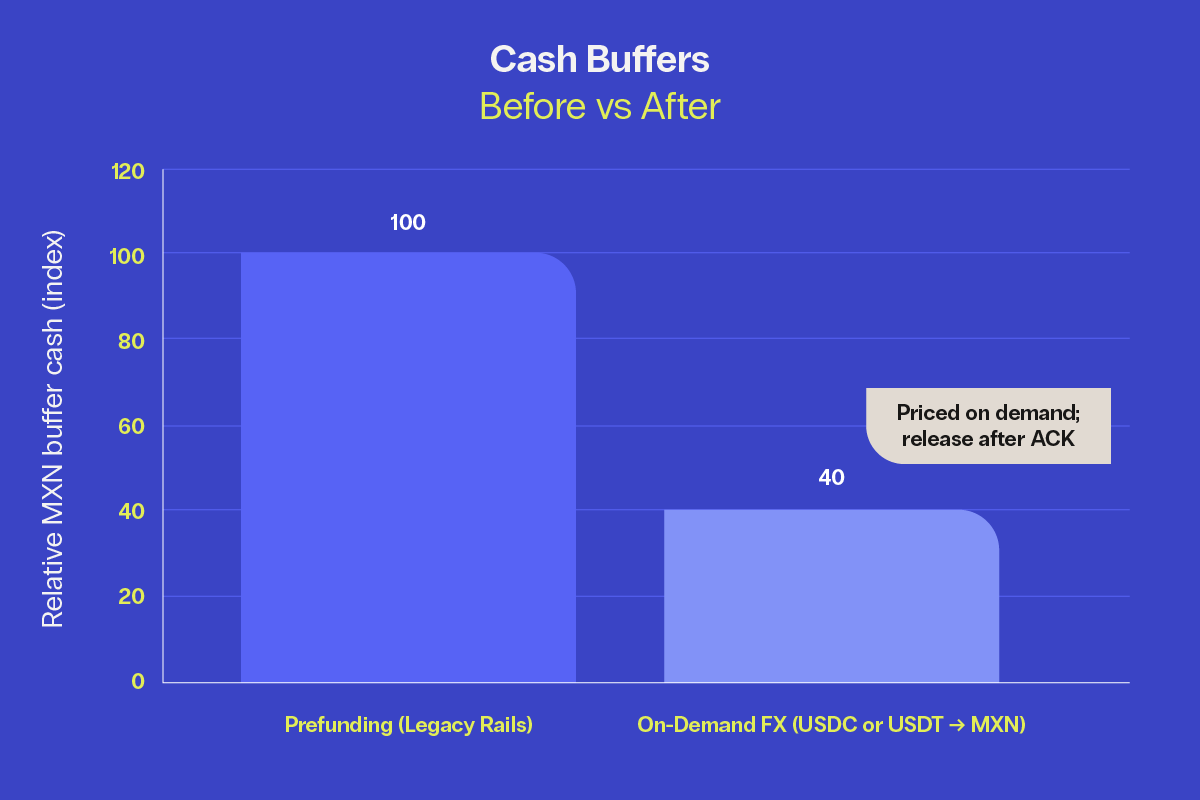
This reduces idle capital, improves FX efficiency, and simplifies reconciliation. On-demand FX significantly lowers buffer cash compared to traditional prefunding models.
USDC or USDT to MXN liquidity reduces idle cash by pricing FX on-demand; figures are illustrative.
How can one API for cross-border payments in LATAM run split payouts and mass payouts in Latin America?
A single API for cross-border payments in LATAM allows companies to manage collections, FX, and payouts within the same infrastructure.
This approach enables:
- Consistent handling of split payouts and mass payouts in Latin America
- Simplified engineering with reusable endpoints
- Real-time status updates through webhooks
- Seamless integration with ERP and treasury systems
With this model, companies can scale from individual payouts to large volume operations without building separate processes.
What controls and compliance should be built in?
- KYC/beneficiary validation: ensure each recipient is verified before the first release.
- Sanctions & screening: automated checks prior to conversion and payout.
- Role-based approvals: two-person approval with audit timestamps.
- Immutable logs: every state change retains payload hashes for evidence.
What is a practical 2 to 4 week implementation plan?
- Map your order object to payout instructions (beneficiary, amount, currency, references).
- Plug webhooks into your ledger so every state change moves the order forward.
- Pilot one corridor (e.g., USD→MXN) leveraging USDC or USDT to MXN liquidity.
- Roll out a single “payouts” service that supports both split flows and mass payouts in Latin America.
- Document exception handling (timeouts, re-quotes, beneficiary changes).
Which KPIs should we track from day one?
- Time-to-settle (T+0/T+1) per beneficiary.
- Automatic match rate (webhook → ledger without manual touch).
- Exception closure <24h with root-cause tags.
- Share of volume routed through stablecoin rails vs legacy rails.
How Bitso Business supports marketplace split payouts
Bitso Business Mass Payouts lets platforms send thousands of payouts in a single API call to bank accounts in major Latin American countries or to crypto wallets, and track each one through the dashboard, the API or webhooks. Consolidated reports simplify reconciliation at the end of every run.
For the conversion leg, the Bitso Business API for cross-border payments in LatAm combines USDC or USDT to MXN liquidity with direct delivery in Mexico through SPEI*. If you are still evaluating the model, our executive guide to stablecoins for business payments covers the fundamentals, and finance teams’ concerns about stablecoins answers the questions CFOs raise most often.
FAQs
What is a split payout in a marketplace?
It is the process of dividing one order’s funds among several beneficiaries, such as the seller, a logistics partner and the platform, each with its own amount, reference and release condition.
Do sellers need a crypto wallet to get paid?
No. Sellers in Mexico receive pesos in the bank account they already use through SPEI. A wallet is only needed for sellers who choose to receive USDC or USDT.
Can we run split payouts without prefunding a peso account?
Yes. Order funds stay in USDC or USDT and each payout line converts to MXN at release time, so there is no need to buy pesos days in advance.
What happens if one payout line fails?
Only that line is affected. The funds stay in the balance with a reason code, the beneficiary data is corrected and the line is sent again without touching the rest of the order.
How long does it take to launch a pilot?
It depends mostly on readiness: release rules defined, beneficiary data validated and tax treatment confirmed. Our guide outlines a four-week framework from scoping to go-live.

*NVIO México enables direct access to SPEI and delivers payment services fully compliant with Mexican regulation. NVIO Pagos México, S.A.P.I. de C.V., IFPE (“NVIO México”) is authorised and regulated by the Mexican National Banking and Securities Commission (CNBV). Learn more at nvio.mx/terms.

Stablecoin liquidity via PIX & SPEI* in Brazil & Mexico

The hidden cost of pre-funding
