
by Bitso on Sep 14, 2026

| Table of Contents |
This content is for informational purposes only. It does not constitute financial, legal, tax or regulatory advice. Each company should validate its implementation with its internal teams and external advisors.
When finance teams consider using stablecoins for business payments, a few concerns tend to come up. Are they too volatile? How safe are they? What about accounting, compliance or depending too much on one provider?
These are all reasonable questions. Some concerns come from how people generally think about crypto, while others point to risks that companies really need to consider.
In this article, we'll look at five common concerns about using stablecoins for business payments, what's behind them and what finance teams should consider before making a decision.
The 5 objections finance teams raise about stablecoins for business payments
Before going deep on each one, here is the scorecard. Some objections hold up, others do not survive contact with how these payments actually work in practice.
|
Objection |
Verdict |
|
1. “Too volatile” |
Mostly myth |
|
2. “Too risky” (issuer / reserves) |
Real and worth checking |
|
3. “Too complicated” (accounting) |
Depends on how you use it |
|
4. “Too crypto” (perception) |
Mostly myth in practice |
|
5. “Too locked in” (one provider) |
Real but avoidable |
Objection 1: “It’s too volatile”
One of the first concerns finance teams have about stablecoins is volatility. Since stablecoins are part of the crypto ecosystem, it's understandable that companies may have questions about how stable their value really is.
However, dollar-backed stablecoins are designed to maintain a value close to $1. While they generally stay near that value, fluctuations can still happen, especially during periods of market stress.
Even though stablecoins are designed to maintain their value, they can still experience fluctuations. For example, USDC dropped to around $0.87 in March 2023 following the collapse of Silicon Valley Bank. USDT also fell to approximately $0.95 in May 2022 during the Terra UST crisis. Both recovered within days, but these situations show why it's important to understand the risks involved.
For companies making cross-border payments in Latin America, one important factor is how long they actually hold stablecoins during a transaction. In many cases, stablecoins are used to move funds between currencies, rather than to hold money for long periods. For example, a company can convert dollars into stablecoins, transfer the funds, and convert them into Mexican pesos within minutes. This helps reduce the time the company is exposed to potential price fluctuations.
For everyday business payments, volatility is generally less of a concern, especially when stablecoins are only held for a short period. Still there are risks to consider. Finance teams should understand how quickly their provider converts funds and which stablecoins and issuers are involved in the process.
Objection 2: “It’s too risky”, what if the issuer or the reserves fail?
This is the objection with the most real substance and it deserves to be treated that way instead of waved off.
Every stablecoin is only as strong as the entity issuing it and the assets backing it. That is not a crypto-specific problem, money market funds and bank deposits carry the same logic but the maturity of that oversight still varies between issuers. Finance teams should know the difference before choosing which stablecoin sits behind a payment flow.
What changed the picture in 2026 is regulation catching up to the question. The GENIUS Act in the US and MiCA in the EU now require permitted issuers to hold reserves 1:1 in high-quality liquid assets and publish regular attestations; the due diligence finance teams used to have to piece together on their own is now a licensing requirement in the largest corridors.
Still, regulation doesn't eliminate every risk. Companies need to review the issuer they're working with just as they would when choosing a bank or another financial provider. Some useful questions include: Is the issuer licensed in the markets where the company operates? Are its reserves independently verified? How often does it publish information about those reserves?
Objection 3: “It’s too complicated”
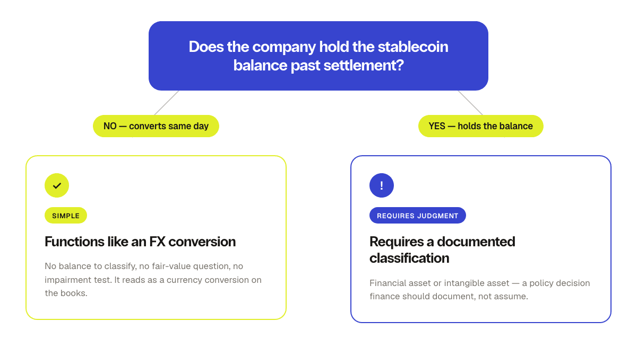
The accounting side of stablecoins depends on how a company uses them. There's a difference between holding stablecoins as part of a company's assets and using them to complete a payment.
In 2023, US accounting standards introduced new rules allowing certain crypto assets to be measured at fair value. However, these changes don't automatically apply to stablecoins. Under ASU 2023-08, assets that give holders an enforceable claim to underlying assets are excluded, which can include fiat-backed stablecoins. This means companies still need to determine how to classify these assets in their financial statements, whether as financial assets or intangible assets. Similar questions exist under IFRS, so the accounting treatment needs to be reviewed and documented.
For companies using stablecoins for cross-border payments, the process can be simpler. When funds are converted into stablecoins and then into local currency within the same transaction, the company may not need to hold a stablecoin balance at the end of the reporting period. For instance, a business paying suppliers in Latin America can convert dollars into stablecoins, transfer the funds and settle the payment in local currency. In this case the transaction works much like a foreign exchange operation.
Using stablecoins this way can help simplify accounting since the company doesn't need to maintain a stablecoin balance over time. Finance teams should still have clear policies for recording these transactions and for any stablecoin balances they decide to hold.
Objection 4: “It’s too crypto”, the reputational objection
This is less a technical objection and more a gut reaction. For some companies, the connection to the crypto industry is still a concern, especially when it comes to security, compliance and reputation.
Some of these concerns are valid. The crypto industry has faced issues involving exchange failures and illicit financial activity. According to Chainalysis's 2026 Crypto Crime Report, the value of funds flowing to sanctioned entities increased by 694% in 2025. Stablecoin issuers have also strengthened their compliance practices, including freezing wallets linked to sanctioned entities.
But when we look at how companies actually use stablecoins, the picture is different. A January 2026 PYMNTS survey of 60 US middle-market CFOs found that among companies already using stablecoins, 88% use them to pay domestic suppliers. The survey also found that 88% of the stablecoins these companies receive are immediately converted into US dollars. In fact, stablecoins are simply another way to move money and complete payments, without necessarily holding digital assets as an investment.
When considering stablecoins for payments, it's important to understand how the process works and what compliance measures are in place. This includes working with providers that follow KYC and KYB requirements and monitor transactions, just as they would with other cross-border payment solutions.
Objection 5: “We’ll be locked into one provider”
The risk of being tied to one provider depends more on how the payment infrastructure is set up than on stablecoins themselves.
For example, if a company builds its payment operations around a single issuer or a closed payment network, switching providers later can become complicated. It may require new integrations, changes to existing agreements or even onboarding counterparties again. Some providers also offer companies the option to issue their own branded stablecoin, which can create additional dependencies.
One way to avoid this is to work with infrastructure that supports multiple stablecoins and payment networks. With a single API for cross-border payments in Latin America, companies can access different options for converting and settling funds without depending entirely on one issuer.
In Mexico, for example, Bitso Business supports dollar-to-peso payments through a regulated IFPE with direct access to SPEI*. This allows payments to be settled through Mexico's interbank payment system. The same flexibility is useful for mass payouts across Latin America, especially for platforms that need to pay large numbers of sellers or contractors in different markets.
Before choosing a provider, companies should understand how easy it would be to switch to another payment network if needed. It's worth asking what changes would be required, how long the process could take and what support the provider would offer.
Putting it all together
Of the five concerns we've covered, three deserve particular attention: the issuer and its reserves, how stablecoins are treated in accounting and the payment infrastructure a company chooses. The other two, volatility and the perception of crypto, are often less of an issue when stablecoins are used specifically for payments and the process is set up correctly.
Stablecoins can offer advantages for business payments, but companies still need to understand the risks and evaluate their options. Before adopting them, it's important to review how the payment process works, what controls are in place and whether the solution meets the company's needs.
FAQs
Do companies need to hold a stablecoin balance to use stablecoins for business payments?
No. Most business payment flows convert dollars in and local currency out within the same transaction, so the company never carries a stablecoin balance on its books.
Which of the five objections has the most real substance today?
Issuer and reserve risk. Reserve composition and attestation frequency genuinely differ between issuers, and that difference is worth checking before choosing a rail, even though 2026 regulation raised the baseline.
Are stablecoins regulated the same way in every market?
No. The US, the EU, Mexico, and other countries in LatAm, each apply a different framework, with different licensing and reserve requirements.
How many companies already use stablecoins for business payments?
Adoption is still early by most measures. A January 2026 PYMNTS survey found that only 13% of US middle-market firms currently use stablecoins, while 58% of CFOs have not yet considered it, even though regulatory clarity has improved.
Does using stablecoins expose a company’s treasury to crypto market swings?
Not in the way most committees imagine. A dollar-pegged stablecoin is designed to track $1, and the businesses that use one to pay suppliers or run payouts typically hold it for minutes, not days, which limits exposure to the rare de-peg events described above.
Simplify and automate stablecoin flows

*NVIO México enables direct access to SPEI and delivers payment services fully compliant with Mexican regulation. NVIO Pagos México, S.A.P.I. de C.V., IFPE (“NVIO México”) is authorised and regulated by the Mexican National Banking and Securities Commission (CNBV). Learn more at nvio.mx/terms.

What to do when cross-border payments in LATAM go wrong

Best FX Solutions for US–LATAM Corridors
