
by Bitso on May 19, 2026

This content is provided for informational purposes only. It does not constitute financial, legal, tax, or regulatory advice. Each company should evaluate its implementation with its own internal teams and professional advisors.
Paying talent across Mexico, Brazil, Colombia and Argentina is not just a payroll task. It is an operational promise. Employees expect predictability, contractors expect speed, and Finance needs every payment to be traceable, approved and easy to reconcile.
For companies hiring across the region without opening a local entity in every market, cross-border payments in Latin America can get complicated fast. Local rails, bank cutoffs, FX timing, beneficiary data, contractor invoices and recurring payout batches all have to work together. The real risk is rarely one failed payment. It is a payroll cycle where exceptions surface too late, Treasury cannot explain the cost, and HR ends up managing frustrated teams.
Why payroll payments in LatAm need a different playbook
Payroll is not the same as paying a vendor. A late invoice creates friction. A late salary or contractor payment damages trust immediately, and that trust is slow to rebuild.
Each market in LatAm has its own payment behavior. Mexico settles through local rails such as SPEI*, Brazil has near universal adoption of PIX for real-time transfers, and Colombia and Argentina bring their own banking windows, FX rules and payout documentation.
Bitso Business supports these flows through stablecoin-powered infrastructure connected to local rails and APIs for businesses operating across the region, using SPEI* and PIX for last-mile delivery into local bank accounts.
|
Key insight: The real risk in LatAm payroll is rarely a single failed payment. It is a cycle where exceptions surface too late for Treasury or HR to react. |
Employees and contractors should not share the same payout workflow
Payroll teams often try to simplify operations by using one process for everyone. In practice, employees and contractors need different controls.
|
Recipient type |
What they expect |
What Finance needs |
Main operational risk |
Better control |
|---|---|---|---|---|
|
Employees |
Exact amount, predictable date, local currency |
Payroll file, approvals, tax or employer records |
Late funding or failed local payout |
Freeze payroll earlier and validate bank data before funding |
|
Contractors |
Fast payment, invoice match, FX clarity |
Invoice, agreement, tax ID, payment proof |
Dispute over rate, date or amount received |
Confirm the currency rule before approving the payout |
|
Remote teams paid from HQ |
Consistent timing across countries |
One funding view across markets |
One country pays on time while another slips |
Use country level payout calendars |
|
High volume freelancers |
Status visibility and repeatability |
Batch reports and exception files |
Manual handling of hundreds of payments |
Use mass payouts in Latin America with API based status tracking |
The goal is not only speed. It is predictability. Payroll should feel routine for the recipient and auditable for Finance.
Choosing the right rail by country
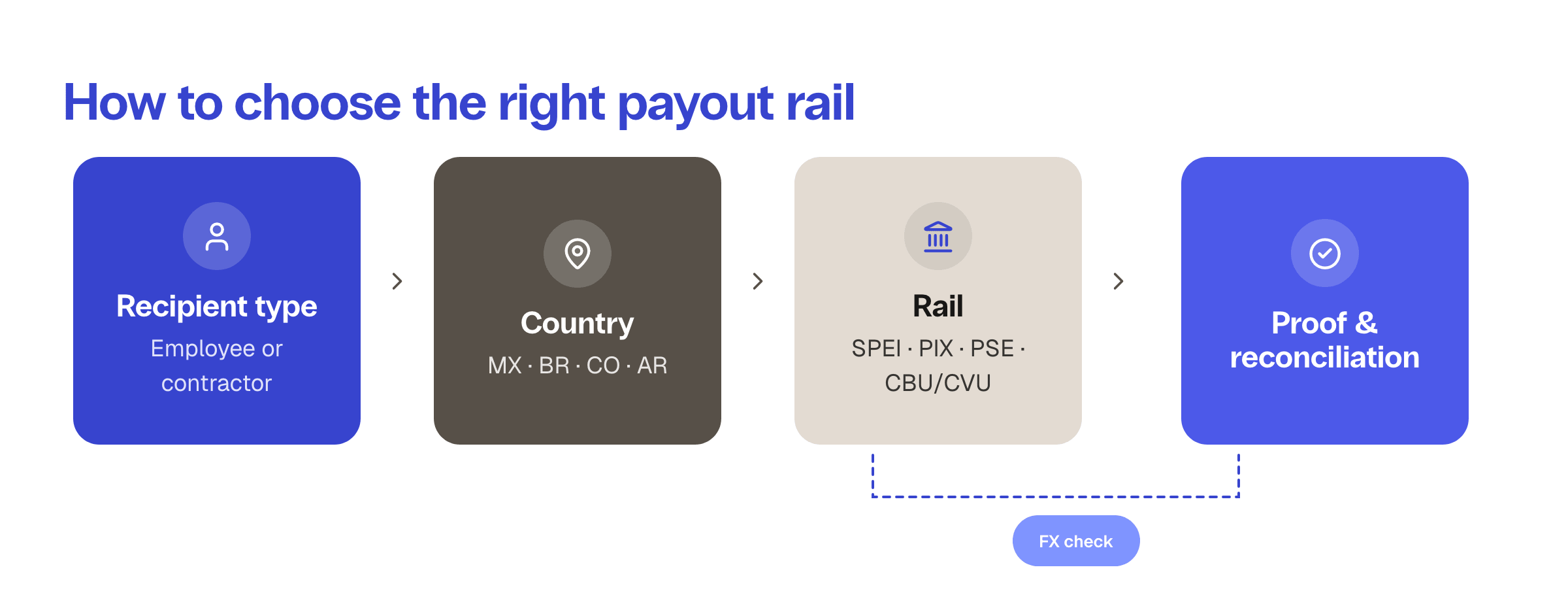
A solid payment setup starts with the recipient experience, then works backward to Treasury and reconciliation.
Mexico
For payroll or contractor payouts into Mexican bank accounts, local transfers are usually the cleanest last-mile. If Treasury funds in USD, USDC to MXN liquidity can help convert value into pesos before the local payout runs through SPEI*, the real-time interbank system Banco de México has operated since 2004. The key decisions are when FX is priced, who approves it and how the quote is stored.
Brazil
Brazilian recipients often expect same day or instant settlement. For contractors, PIX, the instant payment system built and operated by the Central Bank of Brazil, can be a strong fit when the payout partner supports it. The operational risk here is not speed. It is data quality: a wrong key or a mismatched recipient name can still create delays.
Colombia
Colombia usually needs more attention to banking details, recipient validation and timing. For recurring payroll-like flows, avoid approving payout files at the end of the business day. Build a buffer for local processing and exception handling.
Argentina
Argentina requires extra planning because FX conditions and local settlement expectations can shift quickly. For contractors, state clearly whether the agreement is USD denominated, local currency denominated, or paid on a specific conversion rule.
Where stablecoins fit into payroll operations
Stablecoins for business payments can work as a settlement layer, especially when Treasury wants to move value across borders before converting into local currency. They do not replace payroll controls, contracts or compliance. They help with liquidity movement when paired with local payout rails such as SPEI* and PIX.
For payroll, the practical question is not stablecoin or bank. It is which layer should handle which step. Stablecoins can help fund and settle. Local rails deliver the money to the person. Teams that already run mass payouts in Latin America through an API tend to reach this split faster, because the funding and delivery layers are already separated in how the platform works.
Holiday calendars and other timing risks before payday
Rail behavior does not stay constant all year. Each country has its own bank holiday calendar, and a payout file approved the day before a local holiday can settle a full business day later than expected. Mexico, Brazil, Colombia and Argentina do not share the same holiday calendar, and none of them matches a company's home market calendar in the United States or Europe.
A reliable payroll calendar should include the following:
- A country by country cutoff and holiday calendar, reviewed at the start of each quarter
- A funding deadline set before payroll approval, not after
- Bank account validation completed before the cycle starts
- FX approval rules defined for USD denominated contractors
- A named fallback owner for rejected or delayed payments
This matters even more when payroll runs through an API for cross-border payments in LATAM. Automation moves faster than a manual workflow, but only if the calendar and the inputs feeding it are accurate.
Three realistic payroll use cases
1. A SaaS company paying contractors in Mexico and Brazil
The company approves invoices every Wednesday, funds on Thursday and pays Friday morning. Contractors receive local currency, while Treasury keeps its own USD reporting. The team stores the invoice ID, contractor ID, FX rate, payout rail and proof of payment in a single record.
2. A marketplace paying creators weekly
A creator platform pays hundreds of people across LatAm every week. Manual review does not scale, so the team uses batch payouts, API status updates and exception queues instead of reviewing each payment one by one.
3. A remote first company paying talent without opening entities everywhere
The company works with local partners for employment where it is required, but centralizes Treasury and contractor payouts. The goal is not to bypass local rules. It is to reduce account fragmentation and keep one funding and reporting model.
What evidence Finance should keep
For every recurring payroll or contractor payout, Finance should keep:
- Payroll file or approved invoice
- Recipient name, country and payment method
- Currency rule and FX quote when it applies
- Payment instruction and approval trail
- Local rail confirmation
- Settlement timestamp
- Payment proof linked to the internal payroll ID
- Exception notes if a payment failed or was returned
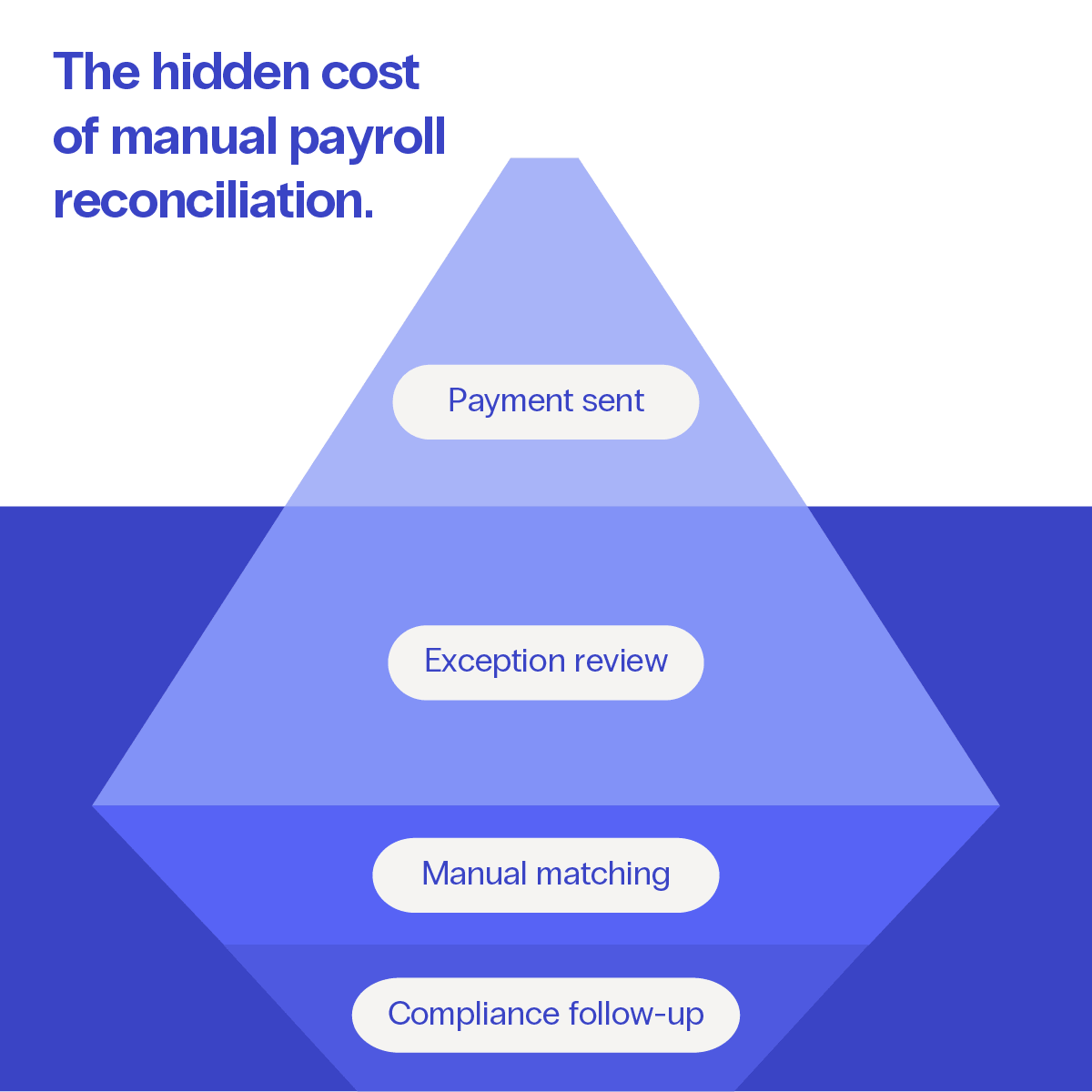
This builds on general reconciliation practice, narrowed to payroll, where every exception carries a human cost and not just an accounting one.
FAQs
Do we need a local entity to pay contractors in Mexico, Brazil, Colombia or Argentina?
Not always for contractors, and the answer depends on the relationship, the tax treatment and local labor rules. Companies should not use a contractor structure to disguise what is functionally an employment relationship, since that exposure sits with the hiring company, not the payment provider.
How do local holidays actually change a payout file, not just the calendar?
A payout approved and funded the day before a holiday in Mexico, Brazil, Colombia or Argentina can still be received by the local rail, but it may not clear until the next business day, since local clearing windows follow each country's own calendar, not the sender's. Building a one day buffer around known holidays avoids most of these surprises.
What should Finance ask a payments provider before switching payroll rails?
Ask how the provider handles rejected or returned payments, how proof of payment is delivered for each rail, whether FX rates are locked before execution or only quoted, and how exception files are formatted for the company's own reconciliation process.
Does funding payroll with stablecoins change how contractors are taxed?
No. The funding and settlement layer a company uses internally does not change the tax treatment of the payment the contractor ultimately receives in local currency. Tax and labor classification depend on the underlying relationship and jurisdiction, not on the payment rail used to fund it.

This content is for informational purposes only and does not constitute financial advice.
*NVIO Pagos México, S.A.P.I. de C.V., IFPE (“NVIO México”), is an entity authorized and regulated by Mexico's National Banking and Securities Commission (CNBV). NVIO México enables direct access to SPEI and provides payment services in full compliance with Mexican regulations.

Global payroll for the remote era

Stablecoins for Business Payments: The CFO Business Case
