by Bitso on Dec 11, 2025
This content is provided for informational purposes only. It does not constitute financial, legal, tax, or regulatory advice. Each company should evaluate its implementation with its own internal teams and professional advisors.
Your company pays suppliers in Mexico, contractors in Brazil and a logistics partner in Colombia. Each payment leaves as an international wire, passes through one or more correspondent banks and can take several business days to land, with fees you only see on the statement. Meanwhile, Treasury keeps cash parked in local accounts just in case.
Cross-border payments in Latin America no longer have to work that way. Every major market in the region now runs a fast local payment system: SPEI in Mexico, Pix in Brazil, PSE and Bre-B in Colombia, and CBU/CVU transfers in Argentina. When a provider connects your company to those systems, the payout to the final recipient can settle in minutes, with less money sitting idle before each payment.
What are the local payment rails in Latin America?
Local rails are the domestic payment systems each country uses to move money between accounts. For cross-border payments in Latin America, four matter most to businesses: SPEI in Mexico, Pix in Brazil, PSE and Bre-B in Colombia, and CBU/CVU transfers in Argentina. All of them are push payments: the payer sends the money, so there are no chargebacks like the ones cards allow.
Mexico: SPEI
SPEI is Mexico’s interbank electronic payment system, operated by Banco de México. It runs every day of the year, around the clock, and funds usually arrive in seconds. Payments go to a CLABE, the standard Mexican account number of 18 digits, and each transfer carries a reference and a payment concept that Finance can use to match it to an invoice. You can review how the system works on Banco de México’s SPEI information page.
Once a SPEI transfer settles, it is final. If you send the wrong amount, you fix it with a new transfer in the opposite direction, not with a reversal.
Brazil: Pix
Pix is Brazil’s instant payment system, created and run by the central bank. It works 24/7 and settles in seconds. Payers can send money with a Pix key (an email, a phone number, a tax ID or a random key), a QR code or full bank details. The Banco Central do Brasil Pix page explains the scheme and its rules.
For business payouts, validating the recipient’s CPF (individual tax ID) or CNPJ (company tax ID) before sending reduces rejected payments. Every Pix transaction also carries a unique ID, which makes reconciliation easier at high volumes.
Colombia: PSE and Bre-B
PSE (Pagos Seguros en Línea), operated by ACH Colombia, is the most common way to collect online payments in the country. The payer chooses their bank, approves the debit and the company receives an immediate confirmation that it can use to release the order or service.
Colombia also has a newer layer: Bre-B, the interoperable instant payment system of Banco de la República, which started operating in late 2025. Bre-B runs 24/7 and lets people and companies send money between banks and wallets using keys, such as a phone number or an ID number. For Finance, PSE remains central for online collections, while Bre-B broadens how instant transfers work between accounts.
Argentina: CBU and CVU transfers
Transfers in Argentina go to a CBU (bank accounts) or a CVU (accounts at payment service providers, such as digital wallets). Both identifiers have 22 digits, and an alias, a readable name linked to the account, helps avoid typing errors. Immediate transfers work 24/7, and through Transferencias 3.0, the Banco Central de la República Argentina made QR payments interoperable across banks and wallets.
For B2B payments, include the payment ID, the recipient’s CBU or CVU and their CUIT (tax ID) so your ERP (Enterprise Resource Planning system) can match each payment to its record.
|
Country and rail |
How you identify the recipient |
What Finance should know |
|
Mexico, SPEI |
CLABE (18 digits) |
Available 24/7; settles in seconds; reference and concept support reconciliation. |
|
Brazil, Pix |
Pix key, QR code or bank details |
Available 24/7; settles in seconds; validate CPF or CNPJ before paying. |
|
Colombia, PSE and Bre-B |
Bank selection (PSE); key (Bre-B) |
PSE for online collections with instant confirmation; Bre-B for 24/7 instant transfers. |
|
Argentina, CBU/CVU |
CBU, CVU (22 digits) or alias |
Immediate transfers 24/7; include CUIT for matching. |
The rails are fast. What separates a smooth operation from a messy one is the integration around them: validating recipient data before sending, managing limits, avoiding duplicate payments and keeping records in sync through automatic status notifications (webhooks).
Do you need a local company in every country to pay or collect?
Not necessarily. A licensed payment provider that already participates in each country’s rails can pay and collect on your behalf, run local compliance checks and issue the records you need for audits. Your company keeps one contract and one integration.
|
Country |
Who supervises |
What your provider should cover |
|
Mexico |
CNBV and Banco de México (rules for IFPE and SPEI participants) |
Corporate KYC (Know Your Customer) and AML (Anti Money Laundering) checks, sanctions screening and reports to the UIF when required. |
|
Brazil |
Banco Central do Brasil (Pix rules); ANPD for data protection |
KYC and AML, fraud controls such as limits by time and channel, and data handling under the LGPD. |
|
Colombia |
Superintendencia Financiera de Colombia |
SARLAFT risk management, validation of the company’s NIT and legal representatives. |
|
Argentina |
BCRA; UIF for AML rules |
KYC and AML, plus tax receipts and withholdings that change the net amount the recipient gets. |
On your side, have these ready before onboarding: corporate documents, ultimate beneficial owners, expected volumes and corridors (for example, US to Mexico), use cases and internal AML policies. How long approval takes depends on the markets and volumes involved; arriving with this information usually speeds it up.
If you fund payments with stablecoins for business payments, one more rule applies. When value moves between virtual asset service providers, the Travel Rule requires both sides to share sender and recipient information, screen sanctions lists and keep a traceable record of each conversion.
How does USD to MXN liquidity work with stablecoins?
Some companies paying into Mexico now fund in USDC or USDT, a stablecoin designed to keep a one to one value with the US dollar, because it moves at any hour and is easy to track.
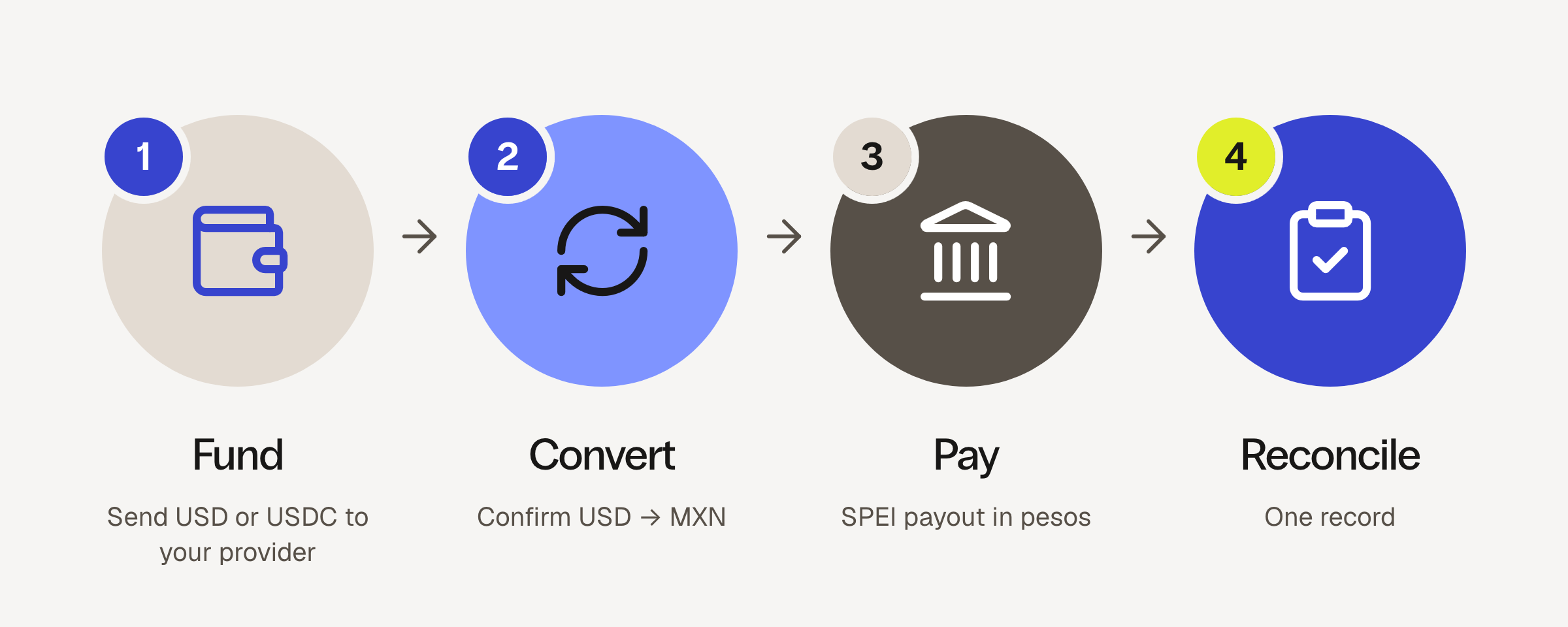
Because stablecoin networks and SPEI both operate outside banking hours, this flow can run at night or on a weekend, when a traditional wire would wait until Monday. It also reduces how much money you need to keep prefunded in Mexico.
For a deeper look at the treasury side, see how to combine SPEI and Pix with stablecoins to free up capital. If you want to see where this already happens, our guide on real use cases of stablecoins for business payments in LATAM covers suppliers, payroll and marketplaces.
What should you ask of an API for cross-border payments in LATAM?
An API for cross-border payments in LATAM should replace several bank relationships with one integration. Use this checklist when you compare providers:
- Collections, payouts and FX under one contract.
- Direct connection to the local rails you need, starting with SPEI in Mexico.
- Operation 24/7, including weekends and bank holidays.
- Webhooks that confirm every status change of a payment.
- A unique ID for each transaction, country and rail, so any payment can be traced.
- One operating ledger that shows funding, conversion and payout together, with the effective cost of each conversion (fees plus spread).
- Batch payouts for payroll, suppliers and marketplace sellers, the basis of mass payouts in Latin America.
- Statements and receipts that are ready for audits.
With that in place, Finance can close the month without stitching together statements from five banks by hand.
How can a company roll out cross-border payments in 90 days?
A phased rollout keeps risk low and gives Finance real data before scaling. This is a reference plan; the actual pace depends on your markets, volumes and internal approvals.
|
Phase |
Days |
What happens |
|
Discovery and compliance |
0 to 15 |
Choose corridors (for example, US to Mexico or Brazil). Define KPIs: settlement time, prefunded capital and cost per payment. Complete KYC and AML. |
|
Build |
16 to 45 |
Connect to the sandbox, test collections, payouts and FX, and set up webhooks. Decide how you will store references and receipts. |
|
Pilot |
46 to 60 |
Run a USD to MXN pilot through SPEI for a small, controlled use case, such as a group of suppliers. Measure total time and effective spread. |
|
Scale |
61 to 90 |
Turn on mass payouts in Latin America, then add other countries. Document how your team handles retries and alerts. |
Before the first payment moves, our readiness checklist for cross-border payments in LATAM covers the five gates to clear in a new market.
How do you prove the impact to your CFO?
Measure these five indicators before the pilot and again after it, so the comparison is fair:
- Capital released: how much money no longer needs to sit prefunded in local accounts.
- Settlement time: from the moment you instruct the payment until the recipient has the funds.
- Cost per payment: fees plus FX spread, not fees alone.
- Automatic reconciliation: share of payments matched without manual work.
- Time to launch: how long it takes to open a new country or corridor.
How Bitso Business supports cross-border payments in Latin America
Bitso Business combines stablecoins, FX and local payment rails in one API for cross-border payments in LATAM. In Mexico, it connects directly to SPEI* through NVIO, so payouts in pesos can settle in minutes, at any hour. The same infrastructure supports USD to MXN liquidity, conversion between local currencies and stablecoins such as USDC or USDT, and mass payouts in Latin America, with one record per transaction for Finance.
FAQs
What information do I need to pay a supplier in Mexico through SPEI?
You need the supplier’s CLABE, the name of the account holder, the amount, a payment concept and a numeric reference. The CLABE has 18 digits: the first three identify the bank, the next three the city, the next eleven the account and the last one is a check digit, so a mistyped CLABE can be caught before sending, as the Asociación de Bancos de México explains. Putting the invoice number in the concept makes reconciliation easier.
How can I prove that a SPEI payment reached the recipient?
Download the Comprobante Electrónico de Pago (CEP) from Banco de México’s CEP site. With the date, the tracking key or reference, the sending and receiving banks, the recipient’s CLABE and the amount, you get a receipt issued by the central bank showing that the transfer was credited. Many suppliers and auditors in Mexico ask for it as proof of payment.
Can I pay a supplier in Mexico in US dollars?
In some cases. Banco de México runs SPID, a system for transfers in US dollars between accounts held by companies in Mexico. It operates on business days only, and the recipient needs a dollar account at a Mexican bank. For suppliers who invoice in pesos, the usual path is to convert USD to MXN and pay through SPEI.
How do I know if the USD to MXN exchange rate I get is competitive?
Compare it with a public reference. In Mexico, Banco de México publishes the FIX exchange rate every banking day based on market quotes, and it is widely used to settle obligations in dollars. Because the market moves during the day, use it as a reference, not a live quote. The gap between your rate and the market rate is the spread; add any fixed fees to see the effective cost of each conversion.
Is USDC backed by US dollars?
USDC is issued by Circle, which states that each token is backed by reserves held in cash and short term US Treasury securities, and publishes monthly attestations by an independent accounting firm on its transparency page. For how rules for stablecoins are evolving for companies, see our guide on stablecoins for business payments: regulations in 2026.
Move money across Latin America in minutes

*NVIO México enables direct access to SPEI and delivers payment services fully compliant with Mexican regulation. NVIO Pagos México, S.A.P.I. de C.V., IFPE (“NVIO México”) is authorised and regulated by the Mexican National Banking and Securities Commission (CNBV). Learn more at nvio.mx/terms.

Cross-border payments in Latin America: a payroll playbook

How can companies achieve faster cross-border payments in LATAM?